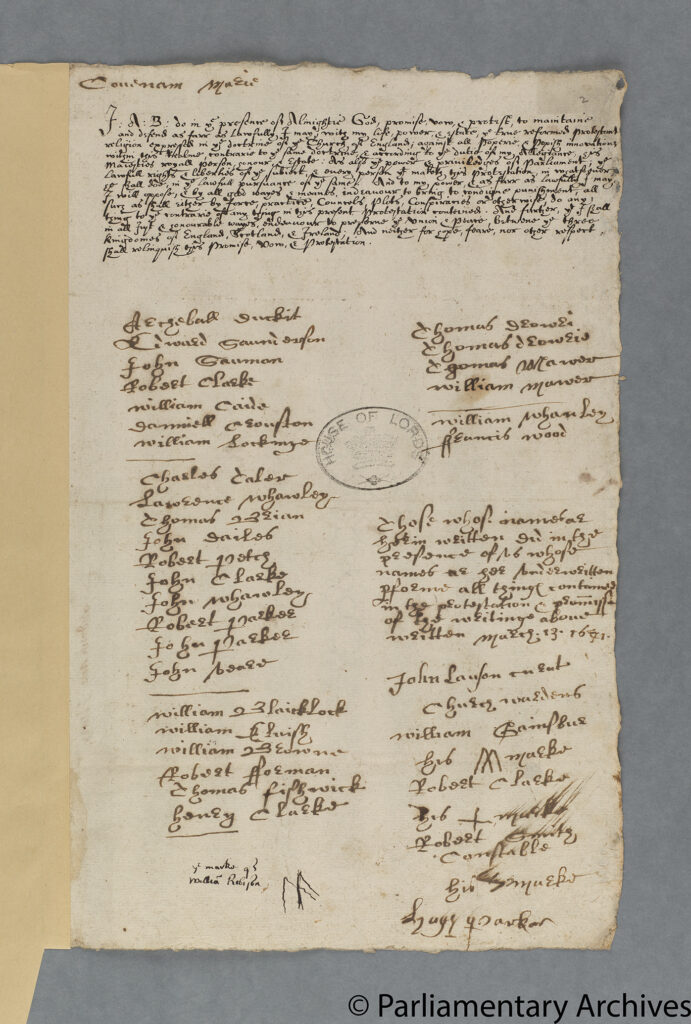
The 1641–1642 Protestation Returns of Covenham
On the eve of the English Civil War, the fabric of local English society was fundamentally altered by a mandate from Westminster: the Protestation Oath of 1641–1642. For the twin parishes of Covenham St Bartholomew and Covenham St Mary in Lincolnshire, this national crisis materialised as a local administrative directive. Today, the surviving Protestation Returns for Covenham offer historians and genealogists an invaluable window into the religious compliance, demographics, and social structures of a 17th-century rural community poised on the brink of war.
Context and the Oath
The Protestation Oath was conceived by the Long Parliament in May 1641 amid mounting paranoia regarding “Popish plots” and deep-seated anxiety over King Charles I’s perceived leanings toward Roman Catholicism. Unlike modern definitions of the word “protestation”, which imply dissent or public demonstration, the 17th-century oath was a solemn public profession of loyalty.
Adult males over the age of eighteen were required to swear to maintain and defend “the true Reformed Protestant Religion,” the power and privileges of Parliament, and the preservation of the King’s person, honor, and estate. In early 1642, Parliament ordered the widespread enforcement of the oath across every parish in England, turning a declaration of loyalty into a nationwide religious and political census.
The Oath
I, A. B., Do in the preſence of Almighty God, promiſe, vow, and proteſt to maintain and defend as far as lawfully I may, with my Life, Power and Eſtate, the true reformed Proteſtant Religion, expreſſed in the Doctrine of the Church of England, against all Popery and Popiſh Innovation within this Realm, contrary to the ſaid Doctrine; and according to the Duty of my Allegiance I will maintain, and defend his Majeſty’s Royal Perſon, Honour, and Eſtate.
Alſo the Power and Privilege of Parliaments, the Lawful Rights and Liberties of the Subjects, and every Perſon that ſhall make this Proteſtation, in whatſoever he ſhall do in the lawful Purſuance of the ſame; and to my Power, as far as lawfully I may, I will oppoſe, and by all good ways and means, endeavour to bring condign Puniſhments on all ſuch as ſhall by Force, Practice, Counſels, Plots, Conſpiracies, or otherwiſe do any thing to the contrary in this preſent Proteſtation contained: And further, That I ſhall in all Juſt and Honourable ways, endeavour to preſerve the Union and Peace betwixt the three Kingdoms of England, Scotland, and Ireland: And neither for Hope, Fear, or any other Reſpects, ſhall relinquiſh this Promiſe, Vow, and Proteſtation.
Parliament's Command and Control
The implementation of the Protestation Oath represented a massive bureaucratic undertaking that fundamentally reshaped how the central government interacted with local communities.
Local Chain of Command
The process circumvented traditional feudal ties, establishing a direct “command and control” pipeline from Westminster to the provinces. Parliament issued letters to county High Sheriffs, who distributed them to regional Justices of the Peace (JPs). These JPs then summoned parish officers to central market towns to receive instructions.
Parish Mobilisation
In the adjacent parishes of Covenham St Bartholomew and Covenham St Mary, the bureaucratic burden fell on a specific cluster of local officials: the parish clergyman, the churchwardens, the constables, and the overseers of the poor. Following a Sunday morning service, these men stood at the church doors to systematically capture the name of every male attendee.
Penalties and Reporting
The bureaucratic pressure was absolute. Any citizen refusing to sign was formally catalogued as a “recusant”, a designation that effectively barred them from public office and subjected them to potential double taxation. Once completed, these physical paper returns were bundled and physically transported back across England to be archived directly in the Houses of Parliament.
Because the original manuscripts survived the centuries, they provide an exact record of the male heads of households and young adults living in Covenham at that precise moment. Preserved in the Parliamentary Archives in London, these documents capture the names of ordinary agrarian workers alongside prominent local gentry, such as branches of the historic Yerburgh (or Yarbrough) family, who held deep ancestral roots in the area.
Lincolnshire and the Coming War
While the Protestation Oath was dressed in the language of consensus, its true impact was deeply polarizing, acting as “the greatest vote of no confidence” in an English monarch since the Magna Carta. For Lincolnshire, the document served as a precursor to the devastating military fracture of the county.
A Divided County
Immediately following the oath-taking in 1642, Lincolnshire split down the middle. King Charles I appointed his own Lord Lieutenant to raise royalist troops, while Parliament commissioned rival emergency leaders. Families whose names were penned side-by-side on the Covenham returns suddenly found themselves on opposite sides of a bloody political divide.
Garrisons and Conflict
The local landscape was quickly weaponised. Strategically vital ports like nearby Boston became heavily fortified Parliamentarian strongholds, while neighboring Newark in Nottinghamshire became a base for aggressive Royalist sorties. Communities across the Lindsey marshlands, including the Covenham area, were subjected to aggressive wartime taxation, military requisitioning, and the constant threat of advancing armies.
Significance as a Historical Source
For micro-historians and genealogists, the surviving Covenham Protestation Returns are of monumental importance.
Result
The Protestation Returns of Covenham St Bartholomew and Covenham St Mary bridge the gap between national narratives and local realities. They demonstrate that the bureaucratic reach of Parliament was capable of infiltrating even the quietest agrarian parishes on the eve of war. For modern researchers, these simple lists of names are far more than bureaucratic relics; they are an extraordinary, tangible link to the ordinary individuals who stood in Covenham’s parish churches nearly four centuries ago, caught in the current of an approaching national storm.
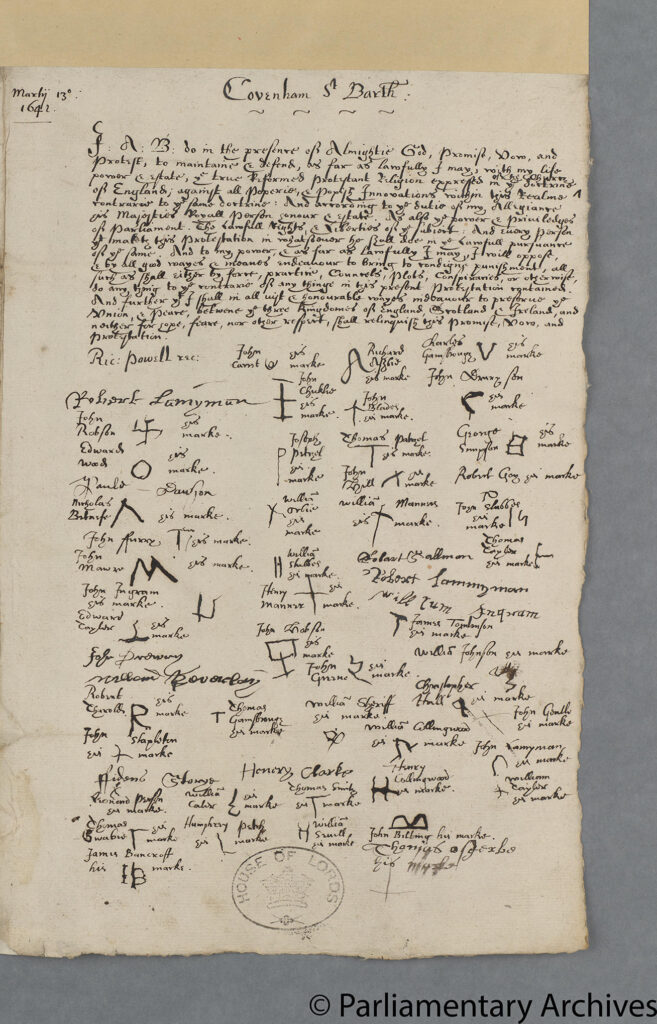
The Return for St. Bartholomew