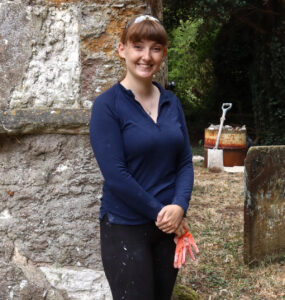
 I’m Holly Whiting and I am a Part Two architectural assistant from Norwich. I’m one of this year’s SPAB Scholars.
I’ve been working on St. Bart’s west elevation of the porch. We have been raking out the cement pointing and removing the cement render from the inside, allowing the stone to breathe a little bit better so helping it to dry out, The next stage is to repoint with a lime mortar, which allows it to be more sacrificial than the stone, thus protecting the stone.
To finish off, we are doing a lime wash on top of it, again to add protection.
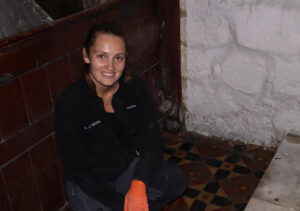
Hello, my name is Suzanne Johnson, and I’m a SPAB scholar for 2026. I’m a structural engineer living in Manchester, and this week I’ve been working on the internal of the church, particularly a little area near the pulpit.
I’ve lime washed the walls after having taken off the cementitious pointing and put lime mortar back into the wall to make sure that it stays dry.
I’ve also worked on cleaning the tiles in that area, and the idea was to give an impression of what the rest of the church might look like once the works have been completed. This lets people get an idea and start to imagine what the works could do to change the appearance of the church through the ages.
In the Royal Painting Infantry! My name’s Han Bee I’m doing the SPAB 2026 Fellowship. I come from a background of carpentry, house renovation, and boat restoration.
Last year, I was part of an experimental “barn build” to build a barn that could be used as a bunkhouse to sleep up to thirteen people. It was disabled accessible and it was a Grindbygg style, which is like a round, locally sourced Douglas fir Norwegian style barn.
The experimental bit was that we did a straw bale wall infill by jacking the building up, putting the straw bales in, and then lowering the jacks back down again to compress the straw bales. It was then lime rendered and lime plastered, all using clay from the local pond on the farm.
The whole summer when we were doing that, I kept wishing there was a course that did a little bit of access and insight into all of the different traditional crafts, historic building skills. Then somebody told me about this SPAB fellowship, so I applied to it, not thinking I’d get it. Luckily for me, they let me do it. It’s absolutely brilliant.
So I’m working on the porch, the outside external porch doors of St. Bart’s, which were just looking a little bit tired and a little bit rusty. So I’ve cleaned them up as best I can. The metalwork I’ve painted with a metal paint.
We’re doing an experimental lime wash finish, which seems to be going really well. The wood seems to like it; it absorbs it really well. And with one coat of lime wash on, it already looks better than it would have done if it had a coat of wood paint on. It also acts a little bit like a filler, so when you’ve got maybe some holes where you’ve had insects eating the wood, or small cracks that have shrunk in the joinery in the doors, the lime wash seems to kind of get in there and just be absorbed by the wood a bit. Really happy with it. Lovely.
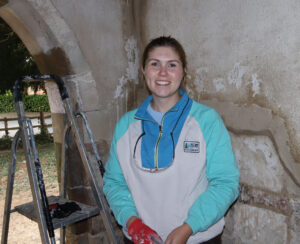 My name is Emily Ducas. I’m a structural engineer. I’m based up in Edinburgh most of the time and I work for a small company called Elliot and Co. We work on historic buildings and highly detailed modern structures. I spend most of my time working in heritage, castles, churches, historic houses in Scotland, and down as far as York. I am on the SPAB Scholarship, I was looking for more consolidation of conservation and learning from specialist craftspeople.
I also want to a better idea of what other projects are going on around the country and how they’re dealing with common issues in heritage. This week I’ve been working in the porch, which is rendered with an earth render. It had a cement render at the base of the wall that’s been chipped off and as we worked our way up, we found that the top of the render is actually earth mortar. This is really good for the wall, so we consolidated the earth mortar.
We’ve mixed a lime slurry for the underside of the render to consolidate the base. We’ve injected a paste of lime putty behind loose sections of the render to bond it back to the wall where the render had separated. I installed a mortar fillet at the base of the wall as well.
We finished off by lime washing the earth mortar and stonework which helps to keep the stonework dry and brighten the unlit porch.
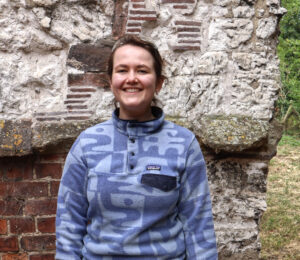 My name is Tara Aveyard. I’m an architect based in Manchester. I work at a practice in Wigan. It’s a very small practice. It splits its time between new build and heritage buildings.
One of the projects I’ve been working on recently and before the scholarship, was a Grade I listed church near Wigan, in a place called Standish. We were doing some spire repair works and the reason I came on the scholarship was to learn a bit more about conservation because it’s the jobs that I really enjoyed at my practice. So at St. Bartholomew’s, Holly and I have been working on the porch. The porch is primarily made out of sandstone and it’s been previously cement pointed.
So we’ve raked out all the cement pointing and we’ve put lime pointing back in and any really friable bits of the stone we’ve thrown on a shelter coat and also lime washed to try and protect and conserve as much of the original material as possible.
It’s been a really enjoyable experience and I’ve really loved being part of something that really benefits the community one day.
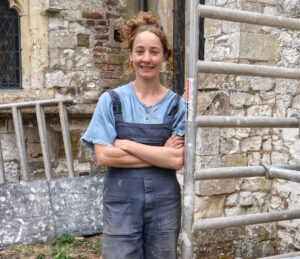 My name is Grace Impesi and I am a time served stonemason. I used to work at Lincoln Cathedral and at the moment I’m working at Durham Cathedral.
I’ve been here for the past week, helping out on this project with Richard Jordan, alongside the SPAB Fellows and Scholars.
Together, we’ve assessed the condition of the church, before taking on a different project to complete.
Really, it’s very important in heritage buildings to use the right materials and to use them in the right way.
We’ve been using hot lime mortars to consolidate the walls and we’re going to be lime washing quite a few sections, just for additional protection, it looks nicer as well.
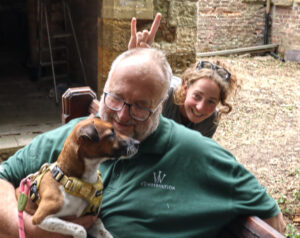 My name’s Richard Jordan. I’m a conservation slater and tiler, bit of a bod with lime and just like working on old buildings. This week was about bringing the SPAB Scholars and Fellows to St. Bart’s Church to try and carry out some repairs to areas of the building that have been neglected for decades.
We’ve basically had four areas that we’ve repaired. We’ve repaired the west-facing wall of the porch externally. Raking the cementitious mortar leaving huge voids.
Consolidating the walls where you could reach right back up to your elbow, replacing it with lime mortar followed by a lime wash.
Working on the inside of the porch we removed all the cementitious plaster leaving the earth mortar in situ. Where the earth mortar was slightly detached we injected hot lime putty to bond the earth plaster back to the stonework. It was finished with a limewash.
We carried out a sample area down near the pulpit, where we, raked out the cementitious mortar repointed with lime mortar and limewash. We then cleaned the geometric tiles on the floor.
We have raked out, taken off the cementitious panels of render on the south-facing chancel wall externally, repointed, consolidated in lime mortar, and then lime washed.
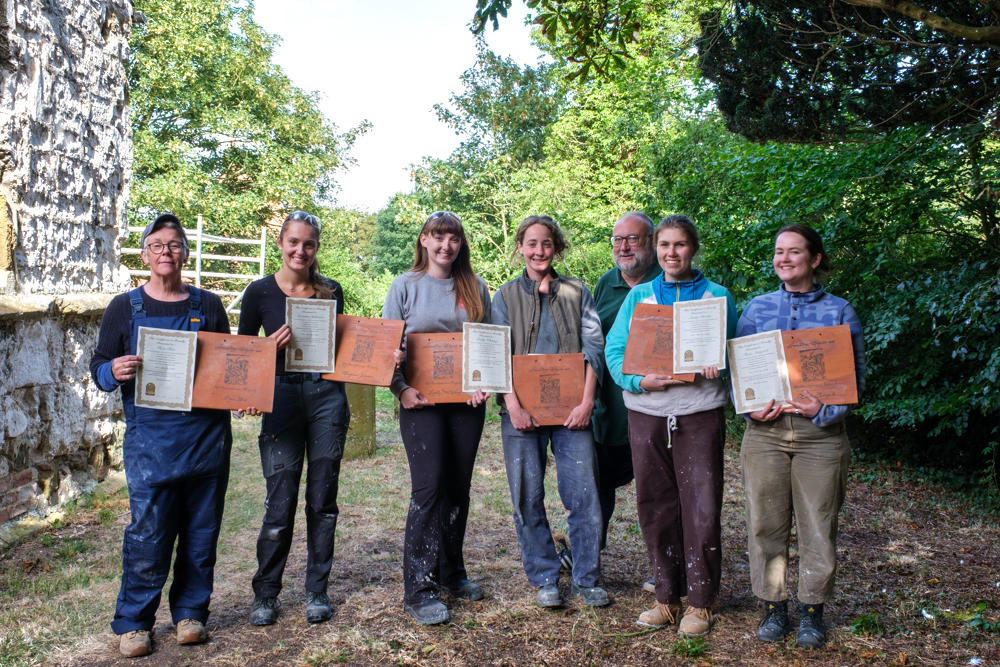
That’s all been done by this year’s 2026 William Morris Craft Fellows and the SPAB Scholars.
There was absolutely brilliant engagement with the community through the cheese and wine evening, sketching evening, and the open day on the Saturday where we’ve probably had twenty people come through. The visit to William Blyth Tiles was well received by the Scholars, Fellows and people from the local community.